


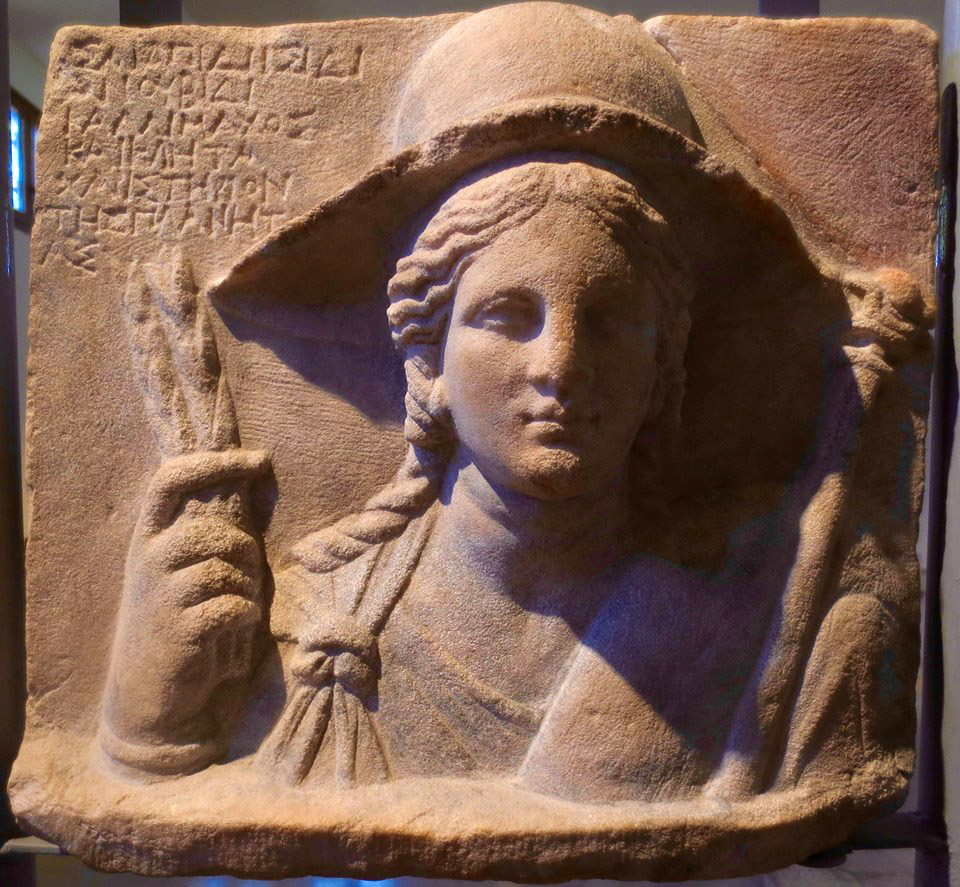
At the beginning of the Homeric Hymn to Demeter, a girl is picking flowers in a meadow. Persephone is there with the daughters of Okeanos, gathering roses, crocuses, violets and irises, when she sees something extraordinary: a narcissus of such beauty that the Hymn gives it a hundred flowers growing from a single root.
As she reaches for it, the earth opens beneath her. Hades comes out in his chariot, seizes Persephone and carries her away. She cries out for her father Zeus, but he has already agreed to the marriage and nobody comes to help her. As the horses carry her down into the darkness, Persephone calls for her mother.

Demeter hears the cry, but does not know what has happened. For nine days the goddess wanders the earth carrying burning torches, taking neither ambrosia nor nectar and refusing to bathe. Hekate has heard Persephone too, but did not see who took her, so eventually the two go to Helios, who sees everything from above.
Helios tells Demeter what has happened. Hades took Persephone, but Zeus gave him permission to do so. He tries to console her: Hades is, after all, Zeus’s own brother and ruler of a great realm, no insignificant husband for the daughter of a goddess.
Demeter is having none of it. She withdraws from the company of the gods and goes among mortals, concealing her divinity beneath the appearance of an old woman. Eventually she reaches Eleusis, where she sits beside a well in the shade of an olive tree.
This is an unusual way to encounter one of the great Olympian gods. There is no shining epiphany or divine procession. Demeter appears as an elderly woman exhausted by grief, sitting alone beside a well, and nobody recognises her.
The daughters of Keleos, king of Eleusis, find her there and ask who she is and where she has come from. Calling herself Doso, Demeter says that she comes from Crete, that pirates carried her away against her will and that she escaped when their ship reached the mainland. Now she is old, alone and looking for a household where she might work as a nurse.
The young women take her home, without realising that they have invited a goddess into a mortal household.
An Old Woman at Eleusis

Keleos and his wife Metaneira have an infant son named Demophon, and the stranger becomes his nurse. Under Demeter’s care the child thrives extraordinarily. She anoints him with ambrosia and breathes sweetness upon him, but at night, unknown to his parents, she begins doing something rather more alarming: she hides the baby in the fire.
The Hymn tells us that Demeter intends to make Demophon ageless and immortal. Whatever divine transformation she has begun might have continued had Metaneira not entered the room one night and seen her son in the fire. She reacts much as we might expect, crying out in horror at the sight of her baby apparently being burned.
Her intervention ruins what Demeter intended to accomplish. The goddess takes Demophon from the flames and angrily tells Metaneira that human beings are foolish, unable to recognise what is good or bad when it approaches them. Demophon will remain mortal, although Demeter promises him lasting honour among the people of Eleusis.
The family now discovers who their mysterious nurse really is. Demeter casts aside the appearance of an elderly woman and reveals herself as a goddess. The Hymn describes her beauty shining out as the house fills with light and fragrance. The family who thought they had taken in a homeless old woman discover that a goddess has been living beneath their roof.
Demeter orders the people of Eleusis to build her a temple and an altar, promising that she will later teach them her rites. They obey, and when the sanctuary is finished she withdraws into it. Her grief for Persephone remains, however, and its consequences are about to spread far beyond the household of Keleos.
The Goddess Who Withholds
Agriculture depends upon an act that remains slightly remarkable however well we understand its biology. You take something you could eat, bury it in the ground and wait, trusting that what disappears beneath the soil will eventually return as something greater.
From grain comes more grain, and from that grain come porridge, cakes and bread. Stored grain can carry a household through the months when little is growing, while a sufficiently good harvest can feed a city. If the seed does not return, none of that happens, and Demeter now makes sure that it does not.
The Homeric Hymn describes a terrible year for mortals. Seed is sown, but Demeter keeps it hidden beneath the earth. Oxen drag ploughs across the fields in vain, barley is scattered into the soil and nothing comes back. Humanity begins to face starvation.
Calling Demeter simply the “goddess of agriculture” rather misses the force of this. For most people in the ancient world, the harvest was the difference between having food and not having it. Demeter does not need to hurl thunderbolts or send a plague to threaten humanity; she needs only to stop giving what normally comes from the earth.
The crisis reaches Olympus because human starvation has consequences for the gods as well. If mortals disappear, so do the sacrifices and honours they give to the immortals. Zeus sends Iris to Demeter and asks her to return, but she refuses. The other gods come one after another, offering gifts and honours, and she refuses them too.
Demeter will neither return to Olympus nor allow the earth to produce its fruit until she sees her daughter again.
The Return
Zeus eventually has to deal with the cause of Demeter’s anger and sends Hermes into the underworld with instructions that Persephone must be allowed to return.
Hades agrees, but before Persephone leaves he secretly gives her a pomegranate seed to eat. When mother and daughter are reunited, Demeter’s first question is whether Persephone ate anything while she was below. The answer means that the separation cannot simply be undone.
Persephone will spend one third of the year beneath the earth and the remaining two thirds with her mother and the other gods, rather than the six months above and six months below of many modern retellings.
The story is also often presented as a straightforward explanation for the seasons: Persephone descends and winter begins; she returns and brings the spring. The Hymn certainly connects her return with renewed fertility, but the agricultural cycle of Greece is less tidy than that. Grain was normally sown with the autumn rains and grew during the winter, while the dry summer was the period when much vegetation withered. The famine in the Hymn occurs because Demeter deliberately prevents the seed from growing, not simply because Persephone is underground.
Persephone herself has changed. Hades tells her that she will rule while she is with him, and elsewhere in Greek religion she appears as a formidable queen of the dead. The girl gathering flowers now belongs both among the Olympian gods and in the realm below.
With her daughter restored, Demeter allows the earth to bear fruit again, but the Hymn does not end with the harvest. She goes to the rulers of Eleusis and teaches them rites that mortals are forbidden to reveal. The story of a mother’s search has become the foundation story of one of the most important religious cults in the Greek world.
The Two Goddesses
At Eleusis, Demeter and Persephone could be worshipped together simply as the Two Goddesses. Their relationship lies at the centre of the sanctuary. Demeter loses Persephone and finds her again, but Persephone now crosses a boundary that her mother cannot abolish. She will descend again.
One of the most striking surviving images from Eleusis shows another figure standing between them. On the great fifth-century BC Eleusinian relief, Demeter and Persephone flank a much smaller youth, usually identified as Triptolemos. Demeter appears to hand him grain while Persephone reaches towards him from the other side.
Triptolemos became closely associated with the spread of agriculture. In vase paintings he sets out in a fantastic winged chariot, carrying Demeter’s gift of grain into the human world. The contrast is striking: the goddess who can keep the seed beneath the earth is also the goddess through whom human beings receive the knowledge of cultivating it.

That gift takes us from divine myth to something much more ordinary. For the Greeks who honoured Demeter, grain was not merely a symbol of death, return or divine power. It was food.
Before There Is Bread
We can see Demeter’s place in ordinary life particularly clearly in a rather less poetic source than the Homeric Hymn: an Athenian inscription concerned with collecting grain.

In the later fifth century BC, Athens regulated the offering of first fruits to Demeter and Persephone at Eleusis. The Attic demes were to contribute specified proportions of their barley and wheat, while other Greek communities were encouraged to make offerings too. Officials collected the grain, accounted for it and stored it, and the decree provided for the construction of three granaries at Eleusis.
There is something useful about encountering Greek religion through administrative paperwork. The grain offered to the Two Goddesses arrived in quantities large enough to require officials, records and buildings in which to put it. The decree also expresses the hope that those who fulfilled their obligations would enjoy good and plentiful harvests.
Demeter was honoured at different moments in the agricultural year. At Eleusis we hear of the Chloia, associated with green shoots, and the Kalamaia, whose name evokes the stalks of the crop. The Haloa, celebrated in connection with Demeter and Dionysus, takes us to the threshing floor. Her worship followed the crop from growth towards harvest.
We can also hear what that relationship sounded like. Theocritus preserves a short invocation to Demeter connected directly with agricultural labour:
“Demeter, Queen of fruit and ear,
bless, O bless our field;
Grant our increase greatest be
that toil therein may yield.”
Those working the land still have to do the work, but they ask Demeter that their labour should produce something.
Elsewhere in Theocritus, in the Thalysia, friends travel to a harvest celebration because Demeter has filled the threshing floor with grain. At its close the speaker looks forward to another harvest:
“Upon whose cornheap I pray I may yet again
plant the great purging-fan, while she stands smiling by
with wheatsheaves and poppies in either hand.”
It is a wonderfully down-to-earth prayer: the hope that there will be another harvest, another heap of grain to thresh, and that the goddess will look favourably upon it.
The Homeric Hymn to Demeter ends on much the same human scale. After Persephone’s disappearance, the famine and the establishment of the rites at Eleusis, the poet turns directly to Demeter and Persephone:
“Come, O Lady resplendent with gifts, queen Dēō, bringer of seasons,
both you and your daughter, the most beautiful Persephone.
Think kindly and grant, in return for this song,
a rich means of livelihood…”
Just before this, the Hymn tells us that when the Two Goddesses favour a mortal they send Ploutos, Wealth himself, to live at that person’s hearth. In an agricultural society, grain in the store, food in the household and the prospect of another harvest were wealth in a very immediate sense.
A later Orphic Hymn to Demeter asks the goddess to come:
“with summer’s rich increase…
leading smiling Peace;
come, with fair Concord and imperial Health,
and join with these a needful store of wealth.”
Across these prayers the concerns remain remarkably recognisable: a fruitful crop, health, peace and enough to live on. These are not quite “graces before meals” in the later sense, and we should be wary of inventing an ancient Greek custom of blessing every loaf. They show instead how food and livelihood could form part of an ongoing relationship with Demeter. People had to plough, sow, harvest and thresh, but whether those efforts produced enough was not regarded as something entirely within human control.
Women, Fasting and the Thesmophoria
Not all of Demeter’s worship centred on Eleusis. One of her most widespread festivals in the Greek world was the Thesmophoria, celebrated by women and associated particularly with Demeter and Persephone.
At Athens the festival occupied three days, known as the Anodos, the Nesteia and the Kalligeneia. The middle day, the Nesteia, was marked by fasting, recalling Demeter’s refusal of food while she searched for Persephone. Aristophanes could build an entire comedy around men trying to infiltrate the festival in his Thesmophoriazusae, which at least tells us how clearly it was understood as belonging to women.
Some of its rituals were considerably stranger to modern eyes. Our most detailed surviving description tells us that piglets were thrown into underground chambers associated with Demeter and Persephone. Later, women known as antletriai, those who drew things up, retrieved the decomposed remains. These were placed on altars and could be mixed with seed in the expectation of a good crop.
It is tempting to tidy this into an elegant symbolic system. Persephone goes beneath the earth and returns; seed does the same; the piglets go down and their remains are brought back up. Ancient ritual does not always oblige us by explaining itself so neatly, however, and much about the Thesmophoria remains uncertain.
What we can see is how physical Demeter’s religion could be. Women fasted, sacrificed, handled the remains of animals and participated in rites concerned with agricultural fertility and, in ways harder for us to reconstruct, human reproduction as well. They were not spectators at the edges of Greek religious life, but participants in one of the major festivals of the civic calendar, conducting rites from which men were excluded.
For another kind of encounter with Demeter, we need to return to Eleusis.
The Road to Eleusis
By the Classical period, those preparing for the Greater Mysteries gathered at Athens before making the journey to the sanctuary. There were proclamations, sacrifices and purification, including a journey to the sea with piglets.
Then came the procession along the Sacred Way, roughly twenty kilometres from Athens to Eleusis. It crossed rivers and passed sanctuaries and sacred places along the route, and it was not a solemn march conducted entirely in silence. There were songs and ritual cries, while at the bridge over the Kephisos participants could encounter ritual joking and abuse. The sacred and the irreverent were apparently quite capable of travelling together.
The initiates also fasted, recalling Demeter’s own refusal of food in the Homeric Hymn. There the grieving goddess refuses wine and instead asks for a drink made from barley meal, water and pennyroyal. The kykeon became part of the later Eleusinian ritual.
Modern speculation has sometimes turned that drink into a psychoactive substance responsible for the initiates’ experience. It is an intriguing possibility, but not something the evidence allows us to present as fact. The drink described in the Hymn is considerably less exotic: barley, water and pennyroyal.
Torches also belonged prominently to the rites, recalling Demeter’s search for Persephone. At Eleusis the initiates entered the sanctuary and, at its heart, the great hall known as the Telesterion. Over the centuries, many thousands of people entered that building, but what they experienced there is where our knowledge begins to fail us.
What Happened Inside?
This is one of the more remarkable silences left to us by the ancient world. The Eleusinian Mysteries lasted for many centuries and attracted initiates from across the Greek and Roman worlds. Men and women could participate, and initiation was not restricted to the citizens of a single polis. Famous writers, politicians and emperors passed through the rites, yet the central mysteries remained secret.
Ancient authors give us hints, and later Christian writers hostile to pagan religion make claims of their own. Modern scholars have assembled these fragments into reconstructions involving sacred objects, ritual dramas, sudden revelations of light and ears of grain. Some suggestions are more plausible than others, but none gives us a reliable script for what happened inside the Telesterion.
The Homeric Hymn to Demeter itself refuses to tell us. After Demeter reveals her rites to the rulers of Eleusis, the poet draws a boundary around them:
“It is in no way possible to ignore the sacred rites,
or to find out about them, or to speak out.
The great awe of the gods holds back any speaking out.”
For once, our ignorance is not simply the result of lost texts or incomplete archaeology. Silence was part of the religion itself. We know a great deal about the road that brought the initiates to Eleusis and remarkably little about what happened once they reached the heart of the sanctuary.
Yet we do know something about what the experience meant to those who underwent it.
Blessed Is the One Who Has Seen
Having established Demeter’s rites at Eleusis, the poet makes an extraordinary distinction between those who have experienced them and those who have not:
“Blessed among earth-bound mortals is he who has seen these things.
But whoever is uninitiated in the rites, whoever takes no part in them,
will never have a share of the same things once dead,
down below in the dank realms of darkness.”
The Hymn does not explain what the initiate has seen, but it insists that seeing it matters beyond the boundary of death.
This does not necessarily amount to the simple promise of a pleasant afterlife sometimes attributed to the Mysteries. Greek ideas about death changed over time, and Eleusinian initiation existed for many centuries. Yet the Hymn plainly connects initiation with the initiate’s fate after death, and later writers continue to speak of Eleusis in language of hope and blessedness.
That gives the story of Demeter and Persephone another dimension. Persephone has gone where every mortal will eventually go. She has crossed into the world of the dead and returned, although she remains bound to it and must descend again. Demeter cannot abolish that fact, either for her daughter or for the mortals who worship her.
What she gives at Eleusis is not escape from mortality. The Mysteries seem instead to have offered a different way of facing it. The farmer who prayed to Demeter for grain and the initiate who entered the Telesterion were not necessarily approaching two unrelated aspects of the goddess. We need the earth to give us what sustains life, and eventually every one of us returns to it. Demeter and Persephone stand on both sides of that relationship.
What Demeter Gives
At the beginning of the Hymn, Persephone reaches for a flower and disappears into the earth. Demeter searches for her, and when she discovers what has happened she threatens the order shared by gods and mortals simply by refusing to let the earth give. The grain remains beneath the soil until her daughter is returned.
Yet the religious world surrounding Demeter is larger than the story of a grieving mother. Women fasted and celebrated her at the Thesmophoria. Farmers and cities offered the first fruits of their crops. Worshippers asked her for another harvest, for health and for enough to live on. Initiates walked the Sacred Way to Eleusis and entered a hall whose secrets many of them apparently carried to their graves.
The same goddess could therefore be approached over the most immediate problem imaginable, whether there would be enough food, and over the one problem no human being can ultimately avoid: death.
The Homeric Hymn does not resolve that tension by pretending that loss can be undone. Persephone returns to her mother, but not for ever. She will descend again. Grain rises from the earth, but it must be sown again. Mortals receive food and prosperity, but they remain mortal.
Perhaps that is why the ending of the Hymn is so effective. After the abduction of Persephone, the famine, the confrontation with Zeus and the revelation of the Mysteries, the poet does not finish with a grand statement about life, death or the order of the cosmos. He turns to Demeter and Persephone and asks the Two Goddesses for something rather more immediate:
“Think kindly and grant, in return for this song,
a rich means of livelihood.”
For all the mystery surrounding Demeter, that is a prayer almost anyone in the ancient world could understand: that the goddesses might look kindly upon you, that the earth might continue to give, and that there might be enough.