


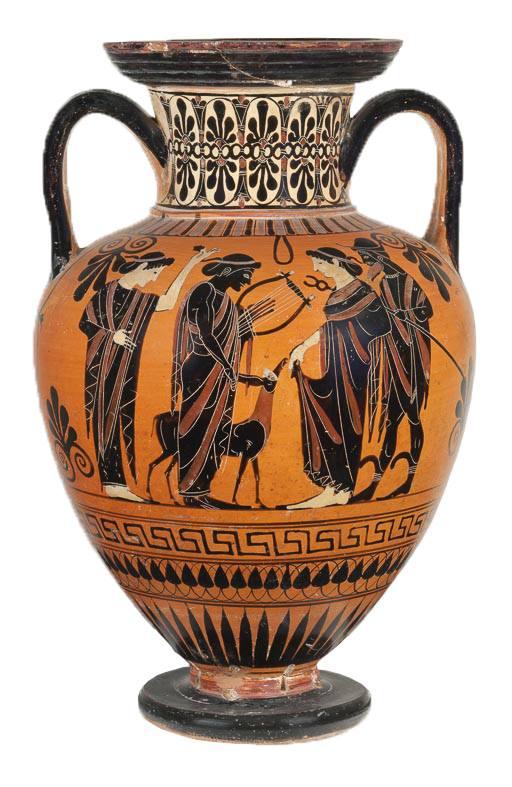
Hermes has been alive for only a few hours when he finds a tortoise outside the cave where he was born.
Most newborn gods might have left it alone. Hermes picks it up, examines it and immediately sees possibilities. He kills the tortoise, hollows out its shell, fits it with reeds and ox-hide and stretches strings across it. By midday on the first day of his life, Hermes has invented the lyre.
He sings for a while, including a song about his own parents and his own conception, and then becomes hungry for meat. So he puts down the lyre and goes looking for Apollo’s cattle.

Hermes playing the tortoise-shell lyre, with cattle before him. Attic red-figure kylix, c. 520–500 BC. British Museum.
The Homeric Hymn to Hermes knows exactly what sort of god it is introducing. In its opening lines Hermes is already a trickster, a cattle-driver, a bringer of dreams, a watcher by night and a “thief at the gates”. The baby has barely left his cradle and his character is already fully formed.
Hermes finds Apollo’s cattle and drives fifty of them away, but even his first theft is unnecessarily clever. He turns the animals around and makes them walk backwards so that their tracks appear to lead in the opposite direction. He disguises his own footprints and drives the herd across the countryside until he reaches the river Alpheios.
There he kindles a fire, slaughters two of the cattle and divides their meat into twelve portions, one for each of the gods. The smell tempts him, but he does not eat. Then, with the evidence disposed of as thoroughly as a divine cattle thief can manage, Hermes makes his way back to Kyllene, slips into his mother’s cave and climbs into his cradle.
Maia is not fooled. Neither, before long, is Apollo.
“I Was Born Yesterday”
Apollo tracks the cattle to Kyllene and finds his younger brother wrapped in his blankets, apparently the picture of infant innocence.
Hermes’ defence is magnificent. He has no idea what Apollo is talking about. He has not seen any cattle. He has not heard anything about them. More to the point, just look at him. He was born yesterday. His feet are soft. His interests are the perfectly reasonable interests of any newborn baby: sleep, his mother’s milk, warm baths and blankets.
“I have not seen them: I have not heard of them.”
Apollo is unconvinced and takes the infant to Zeus.
Hermes tries again. He assures his father that he will tell the truth, because he is truthful and does not know how to lie. He denies stealing the cattle and complains that Apollo is accusing a helpless newborn.
Zeus laughs.
The cattle are eventually recovered, but the story does not end with punishment. Hermes takes out the instrument he made that morning and begins to play. Apollo is entranced. Suddenly he wants the lyre more than he wants revenge.
An exchange follows. Hermes gives Apollo the lyre, and Apollo gives Hermes authority over the cattle. Other gifts and honours follow, and the quarrel between the brothers becomes friendship.
It is an extraordinary first day. Hermes has invented music, stolen cattle, made a sacrifice, lied to Apollo, argued his case before Zeus and negotiated his way into a considerably better position than the one in which he started.
Already some of the apparently unrelated things that will later belong to Hermes are gathering around him: livestock, cunning, persuasive speech, property, theft, exchange and profit. The Homeric Hymn gives us a god who moves things around, crosses lines and finds opportunities where nobody else has noticed them.
For Hermes, boundaries seem to invite investigation.
At the Edge of the Road
If you travelled through the Greek world, Hermes might quite literally be waiting beside the road.

Herms, squared pillars bearing the head and phallus of Hermes, stood at roads, boundaries, crossroads and entrances throughout the Greek world.
One of the most distinctive objects associated with him was the herm. In its familiar form this was a squared stone pillar, usually carrying the bearded head of Hermes at the top and an erect phallus on the front. To modern eyes they can look peculiar, but herms were placed in thoroughly practical locations: beside roads, at boundaries and crossroads, at gates, outside houses and in public spaces.
A doorway separated the familiarity of the house from the world outside. A boundary marked where one person’s land or one community’s territory ended and another began. A crossroads presented the traveller with a choice about where to go next. Hermes belonged naturally in such places.
He could be Hermes Enodios, Hermes of the Road, a god encountered by travellers as they moved through the landscape. A journey in the ancient world involved uncertainties that are easy to underestimate when roads come with signposts, maps, mobile phones and a reasonable expectation of finding somewhere to buy lunch. Travel meant leaving home and entering a world of strangers, unfamiliar territory and unpredictable encounters.
The importance of these images became dramatically clear in Athens in 415 BC. On the eve of the great Athenian expedition against Sicily, people woke to discover that many of the city’s herms had been mutilated during the night.
The reaction was extraordinary. The Athenians launched investigations, rewards were offered for information, accusations spread and the affair became entangled with suspicions of conspiracy against the democracy. Alcibiades, one of the commanders of the Sicilian expedition, was among those caught up in the wider scandal.
The timing made the event particularly ominous. An enormous fleet was preparing to sail into the unknown, and somebody had attacked images of a god associated with roads, boundaries and travellers. Whatever the perpetrators intended, the Athenians did not treat the damaged herms as vandalised street furniture.
Hermes in the Hills
It would be easy from all this talk of roads to imagine Hermes principally as a god of travellers moving between cities. His roots, however, take us into a much more rural landscape.

Hermes Kriophoros, the Ram-Bearer. Late Archaic Greek bronze statuette, late sixth century BC. Museum of Fine Arts, Boston.
Hermes is born on Mount Kyllene in Arcadia, a region of mountains, grazing land and pastoral communities. The Homeric Hymn calls him lord of Arcadia rich in flocks, and his association with sheep, goats, cattle and shepherds remained an important part of his worship.
One form of the god was Hermes Kriophoros, the Ram-Bearer. Pausanias tells a story from Tanagra in which Hermes saved the city from plague by carrying a ram around its walls; in commemoration, the most handsome young man of the city continued to carry a lamb around the walls at the festival of Hermes.
For a pastoral community this was no obscure corner of divine responsibility. Flocks represented food, clothing and wealth. The god who stole Apollo’s cattle on the evening of his birth was also a god honoured by people whose livelihoods depended upon animals of their own.
In rural votive reliefs Hermes can appear alongside Pan and the Nymphs, inhabiting a religious landscape of caves, springs, mountains, shepherds and grazing animals. This Hermes is a long way from the polished messenger racing between Olympus and the mortal world in later imagination. He belongs to the track through the hills as much as to the road between cities.

Young Men and the Gymnasium
Hermes was also waiting in another important part of Greek life: the gymnasium.
Alongside Herakles, he became one of the gods most closely associated with the gymnasium and palaestra. Young men trained, wrestled and competed under his patronage, and festivals called the Hermaia were celebrated in gymnasia across the Greek world.
Plato gives us an incidental glimpse of this in the Lysis. Socrates encounters a group of young men celebrating the Hermaia at a palaestra. The philosophical conversation is what interests Plato, but for us the background is revealing. A festival of Hermes taking place among young men at their place of training requires no explanation from him.
Inscriptions make the relationship even more tangible. Groups of ephebes, young men undergoing civic and military training, made dedications to Hermes. Victors in athletic competitions dedicated prizes to him, while gymnasium officials could dedicate images of the god.
These are useful scraps of evidence because they take us beyond the convenient modern habit of assigning each Greek god a list of responsibilities. We do not simply know from a mythological handbook that Hermes was “god of athletes”. Young men who trained and competed left dedications to him.
The gymnasium was itself a place of transition, as boys became men and entered more fully into the life of the community. We should be wary of making every aspect of Hermes fit too neatly into a single interpretation, but a god of skill, competition and good fortune had an obvious place there.
In the Agora
From the gymnasium we can follow Hermes into another busy public space.
Hermes Agoraios belonged to the agora, the marketplace and civic centre where people met, talked, argued and exchanged goods. Here his connections with merchants, commerce, profit and good luck come to the foreground.
A marketplace is full of things changing hands. Goods and money pass between people. Strangers meet, information circulates, prices are proposed and disputed, bargains are made, and success can depend as much upon timing and persuasion as upon what is actually being sold.
It is perhaps not entirely surprising that the god of merchants was also the god of thieves. Both activities involve transferring property from one person’s possession to another. The crucial difference is whether the previous owner agreed to the transaction.
Hermes could also be associated with unexpected gain and lucky finds, the fortunate thing encountered by chance. The baby who looks at a tortoise and sees a lyre, or at Apollo’s cattle and sees an opportunity, remains recognisable in the god of the marketplace.
The agora could also be somewhere you went when you wanted Hermes to answer a question.
Ask Hermes
At Pharai in Achaia, Pausanias encountered one of the more appealing forms of ancient Greek divination.
There was an image of Hermes in the marketplace, and someone wishing to consult the god came to it in the evening. The worshipper burned incense, filled and lit the lamps beside the altar, placed a local coin upon it and whispered a question directly into the ear of Hermes.
Then came the important part. The questioner covered their own ears and walked away from the image. Only after leaving the marketplace did they uncover them, and the first words they heard another person say were accepted as the god’s answer.
There is something wonderfully characteristic of Hermes about this. Apollo’s oracle at Delphi speaks from one of the great sanctuaries of the Greek world through the Pythia. At Pharai, an ordinary scrap of human conversation could become the means through which Hermes answered.
A greeting, an argument, somebody calling to a friend: whatever words reached the worshipper first acquired another significance because a question had been put to the god before hearing them. Hermes, the god who carries words, could make words already passing between human beings carry something more.
A Place at the Table

Hermes could be encountered on a much smaller scale as well.
In the Odyssey, when the swineherd Eumaios prepares a pig for his guest, he does not simply cook it and begin eating. He sacrifices, divides the meat into portions and sets one aside for the Nymphs and Hermes, accompanying the offering with prayer.
Elsewhere in the poem, when Odysseus is among the Phaeacians, the company pours its final libations to Hermes before going home to sleep.
These are easy details to pass over because Homer does not stop to explain them. That is precisely why they are useful. Honouring Hermes is simply part of what people do.
A short Homeric Hymn to Hestia gives us another glimpse of the god within the household. After invoking Hestia, the poet turns to Hermes:
“Son of Zeus and Maia, messenger of the blessed gods, bearer of the golden rod, giver of good, be favourable and help us…”
The hymn then asks Hermes and Hestia together to:
“Come and dwell in this glorious house in friendship together…”
It is a lovely pairing. Hestia, whose place is at the hearth, and Hermes, who seems incapable of staying anywhere for very long, can both be welcomed into the same household. We need not turn that into an elaborate theological opposition that the hymn itself does not make. It is enough to notice that the god encountered on roads, at boundaries and in the marketplace could also be honoured at home.
Offerings to Hermes need not always be extravagant either. Much later, Philostratus tells a story in which wealthy worshippers bring Hermes gifts of gold, silver and ivory, while Aesop has nothing comparable to offer. His gifts are simple: milk, honeycomb, and potentially berries or flowers.
The story comes from a much later literary world and should not be treated as a description of everyday Classical practice, but the idea behind it would have been recognisable. Greek worship was shaped by kharis, a word that can mean grace, favour or gratitude, and by the reciprocal relationship between worshipper and god that grew through prayer, offerings and divine favour. It was not simply a transaction in which a sufficiently expensive gift purchased the result you wanted. You honoured the gods, thanked them for what they had given, asked for their goodwill and hoped that the relationship would continue.
That makes the language of the short Homeric Hymn to Hermes particularly appropriate. The poet addresses Hermes as a giver of kharis as well as a guide and giver of good things. For a god so closely associated with exchange, the exchange between mortal and divine was about rather more than the value of what was placed on the altar.
The God Who Carries Words
We have got surprisingly far into an article about Hermes without describing him as the messenger of the gods.
That is deliberate. Calling Hermes “the messenger god” is not wrong, but it can make one of the most interesting Greek gods sound as though Zeus employed him to deliver correspondence.
Hermes is a herald, and heralds mattered. They carried messages between people who might be separated by distance, political boundaries or hostility, and their role depended upon the words they carried being recognised as coming from somebody else. Hermes performs the same function between gods and mortals and, when necessary, between different divine realms.
A dedication from the Athenian Acropolis around the beginning of the fifth century BC makes the relationship particularly tangible. A professional herald dedicated a thank-offering to Hermes.
A mortal herald thanking the divine herald needs very little explanation.
But Hermes was concerned not only with carrying words. Eloquence, persuasive speech and the ability to use language effectively also belonged to him. The Orphic Hymn to Hermes asks the god for help in terms that are surprisingly personal:
“assist my works, conclude my life with peace,
give graceful speech, and memory’s increase.”
The worshipper is not asking Hermes to carry Zeus’s instructions somewhere. The request is for help with one’s own undertakings, for the ability to speak well and to remember.
By now a pattern has emerged. A messenger carries words between people. A merchant exchanges goods. A traveller passes from one place into another. A herald can cross political boundaries. Hermes is repeatedly found at the point where something must move, change hands or pass from one sphere into another.
It does not explain everything about him, nor should we expect one formula to contain a Greek god. But it helps us understand why one of Hermes’ darker roles belongs so naturally beside the others.
The Road Below
When Zeus needs someone to go into the underworld and bring Persephone back to Demeter, he sends Hermes.

By this point the choice feels almost inevitable. Hermes can go where the message needs to go. Olympus, the mortal world and the kingdom of Hades are all open to his journeys.
His ability to cross that final boundary gave Hermes another role: Psychopompos, the guide of souls.
At the beginning of Book 24 of the Odyssey, the suitors whom Odysseus has killed are ready to begin their last journey. Hermes appears carrying his beautiful golden wand, with which he can close the eyes of mortals in sleep or wake them again, and summons their souls.
They follow him.
Homer compares them to bats squeaking and fluttering in the depths of a cave. Hermes leads the dead past the streams of Ocean, the White Rock, the gates of the sun and the land of dreams, until they reach the asphodel meadow where the souls of the dead dwell.
The imagery is very different from the first journey we saw Hermes make. There is no stolen herd, no backwards footprints and no indignant infant protesting his innocence. Hermes simply knows the road, and the dead follow him along it.
Later religious language makes the role explicit. An Orphic Hymn to Chthonic Hermes addresses him as the god who moves through Persephone’s realm and calls him:
“to wretched souls the leader of the way”
before inviting the god to come favourably to the sacrifice.
The traveller, herald and guide of the dead are not identical roles, but they share something recognisable. Each requires passage between places that are separated, and Hermes is repeatedly the god who knows the way through.
The God Who Crosses
The Homeric Hymn introduces Hermes as a newborn who seems constitutionally incapable of remaining where he has been put. He leaves his cradle, turns a tortoise into a musical instrument, crosses the countryside, steals another god’s cattle, invents ways to conceal his journey, talks his way through confrontation and finally turns a theft into an exchange of gifts.
By the end of his first day, Hermes has found his place among the gods.
The Greeks encountered him in similarly transitional places. His image stood beside roads and at boundaries, crossroads and doors. Shepherds honoured him among their flocks, young men in the gymnasium, merchants in the agora and households at the meal. A worshipper at Pharai could whisper a question into his ear and then walk back into the world listening for his answer. Heralds honoured him when carrying words, while travellers could look to him when setting out along the road.
And when the road led somewhere no living traveller could follow, Hermes still knew the way.
There is a temptation with Greek gods to make them tidier than they were, to find the single idea that explains every epithet, myth and local cult. Hermes in particular resists that treatment. The god who guides travellers also steals cattle; the patron of persuasive speech is an accomplished liar; the giver of good fortune can be patron of a thief; the god welcomed into the house is perpetually on the road.
Yet across those contradictions a pattern remains. Hermes appears again and again where something is in motion, where a boundary is being approached or where passage from one condition to another is uncertain. Sometimes he protects that passage. Sometimes he enables it. Occasionally he is the reason the boundary has been crossed in the first place.
Perhaps that is why Hermes could matter in circumstances both ordinary and profound. A journey, a business deal, an athletic contest, a difficult conversation or an uncertain decision all involve stepping into something whose outcome cannot be entirely controlled. The final journey into death merely takes that uncertainty to its furthest possible boundary.
A journey does not have to lead to the underworld to be uncertain. Sometimes you simply have to leave the familiar place where you are standing and take the road ahead.
For that, the Greeks had Hermes.