


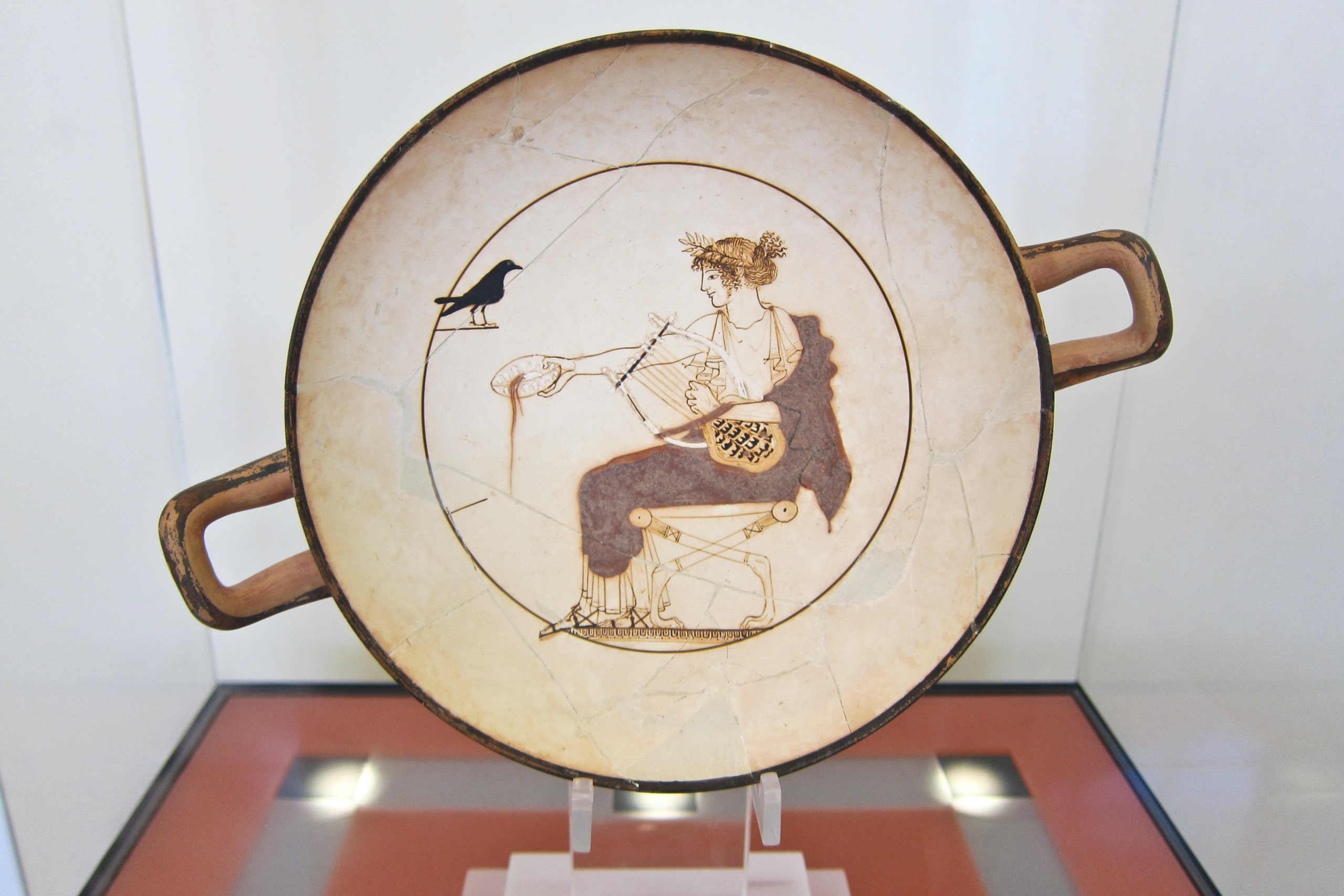

Apollo with bow and kithara. Attic red-figure vase painting.
At the beginning of the Iliad, an old priest walks away from the Greek camp in despair. His name is Chryses, and his daughter has been taken captive and given to Agamemnon. He has come to the Greek ships carrying a ransom and wearing the sacred fillets of Apollo, hoping to buy her freedom. The other Greeks are willing to accept, but Agamemnon is not, and sends the old man away with threats.
Chryses walks down beside the sea and prays:
“Hear me, Silver Bow…”
He reminds Apollo of the temples he has roofed for him and the sacrifices he has offered, then asks the god to make the Greeks pay for his tears. Apollo hears him.
The god comes down from Olympus in anger, carrying his bow. Homer gives us one of the great entrances in Greek literature: the arrows rattle against Apollo’s shoulders as he moves, and he comes like night. Sitting apart from the ships, he draws his bow. At first his arrows strike the animals, then they strike men, and for nine days the funeral pyres burn.
This is how Apollo enters the Iliad: not as a gentle god of sunshine and poetry, but as something altogether more unsettling. Yet the most revealing part of the story is not simply that Apollo can send plague. It is why he has come at all. Someone prayed, and the god heard.
The God Who Hears
Chryses does not approach Apollo as a stranger, but reminds the god of the honours he has given him: temples, sacrifice and the continuing relationship between worshipper and deity that the Greeks could express through the idea of kharis, favour or goodwill.
His prayer therefore has a history behind it. Chryses has honoured Apollo before and now, in distress, he calls upon that existing relationship and asks the god to remember him. This is not quite a transaction, as though a certain number of sacrifices purchase a divine favour. It is a relationship sustained through honour, giving and remembrance.
The Greeks eventually realise that their suffering has a cause. Agamemnon has dishonoured Apollo’s priest and refuses to return his daughter. Chryseis is restored, sacrifice is made and Chryses prays again, this time asking Apollo to remove the plague. Once again Apollo hears him.
The same god who sent the disease takes it away.
This may seem contradictory if we approach the Greek gods as though each had a clearly defined job. Apollo heals, therefore surely disease ought to belong to somebody else. Greek divine power does not always divide itself so conveniently.
The bow offers one way of understanding Apollo’s power. His arrows strike suddenly and from a distance; a person may fall without ever seeing what struck them. Disease can feel much the same. Yet the power that sends affliction may also have the power to remove it.
Apollo can be invoked as Paian, the healer, and Asklepios, the great healing god, is his son. But Apollo’s relationship with health cannot be reduced to benevolent medicine. In the Iliad, the plague ends only when the offence against his priest has been put right.
More Than a Sun God
Modern introductions often describe Apollo as the Greek god of the sun, music and prophecy. None of those associations is invented, although his identification with the sun becomes much stronger in later antiquity. As a description of the Apollo whom Greeks actually worshipped, however, the familiar list tells us remarkably little.
Apollo could be Pythios at Delphi, Paian when approached as healer, Agyieus at streets and doorways, or Archēgetēs, the leader or founder. These epithets are more than decorative surnames. They tell us something about the circumstances in which people approach the god, without any one of them containing the whole of Apollo.
The Homeric Hymn to Apollo brings several of these apparently different aspects together almost from the moment of his birth. Once the newborn Apollo has been given ambrosia, he breaks free of his swaddling bands and announces what will matter to him:
“Ever belovèd to me may the kithara be, and the curved bow;
I will declare to mankind great Zeus’s infallible purpose.”
The combination is striking. The lyre, the bow and prophecy stand beside one another in Apollo’s own declaration. The hymn does not appear to find this mixture of music, violence and divine knowledge in need of explanation.
To encounter that prophetic Apollo, however, we need to go somewhere people travelled specifically because they wanted an answer from him.
We need to go to Delphi.
At Delphi, Ask a God

Suppose you have a question that matters. Perhaps your city is considering sending settlers across the sea, or a war is approaching and nobody knows whether it should be fought. A disaster has struck, some act of bloodshed has left a pollution that must be dealt with, or perhaps the question is simpler and more personal. Either way, there are decisions for which human judgement does not seem enough.
So you go to Delphi.
For many travellers, this is no short journey. You cross mountains and valleys before climbing towards the sanctuary on the slopes of Mount Parnassos. As you approach, the landscape itself becomes dramatic. The sanctuary lies above the valley of the Pleistos, with the great cliffs of the Phaedriades rising behind it. This is the place Greeks know as the centre of the world, marked by the omphalos, the navel stone.
You enter the sanctuary and follow the Sacred Way uphill. Around you are monuments erected by cities from across the Greek world, statues, dedications and treasuries filled with gifts to the god. They are reminders that you are far from the first person to come here seeking Apollo. Athenians, Spartans, Corinthians, islanders, kings and envoys from distant cities have all made their way here, some of them travelling much farther than you.
Above them stands the temple of Apollo, and you have not come simply to visit it. You have come to ask a god a question.
Nor did one simply walk into the temple and demand an answer. Consultation belonged within ritual. Sacrifice and purification formed part of approaching Apollo, and the Pythia herself prepared before taking her place within the temple. The details changed over time and our evidence does not allow us to reconstruct every consultation with confidence, but communication with Apollo took place within sacred space and established religious practice.
That is worth dwelling on, because familiarity with the phrase ‘Delphic Oracle’ can make the whole thing seem almost ordinary. Within the religious world of the Greeks, something remarkable is taking place. A mortal who does not know what to do can come to Apollo’s sanctuary, approach the god through the appropriate rites, put a question to him and hope to receive an answer.

An Attic red-figure kylix from Vulci (Italy), 440-430 BC, depicting King Aigeus in front of the Pythia at the Oracle of Delphi.
The answer comes through the Pythia, Apollo’s priestess. Much later imagination has surrounded her with clouds of intoxicating vapour and incoherent ravings interpreted by male priests, but the ancient evidence gives us no reason to make that familiar picture our starting point. For those who came to Delphi, the essential claim was much simpler: they asked, and Apollo answered.
People did not come only because they wanted the god to reveal the future. Cities consulted Apollo about colonies, war, religious practice and the proper response to pollution or disaster. The question might not be ‘What will happen?’ at all, but the rather more urgent ‘What should we do?’
Delphi was therefore something more interesting than an ancient fortune-telling service. Mortals could deliberate, argue and make plans, but when human judgement reached its limits they could seek the counsel of a god.
There was, however, no guarantee that they would understand what they heard. For that, we need to meet a king named Croesus.
When a God Answers, Who Understands?
Croesus was king of Lydia, fabulously wealthy and ruler of a powerful kingdom in western Anatolia. By the middle of the sixth century BC, however, another power was rising beyond his eastern frontier. Cyrus the Great had created a Persian empire, and Croesus faced a question with enormous consequences: should he attack?
Before asking the gods for advice, Croesus decided to find out which oracle could actually be trusted. Herodotus tells us that he sent messengers to several famous oracles with identical instructions. They were to wait until the hundredth day after leaving Sardis and then ask what Croesus, king of Lydia, was doing at that precise moment.
Croesus had made the test deliberately impossible to guess. On the appointed day he did something, as Herodotus remarks, that would be very difficult for anyone even to imagine: he chopped up a tortoise and a lamb and boiled them together in a bronze cauldron with a bronze lid.
At Delphi, before the messengers had even asked their question, the Pythia spoke:
“I know the number of the sands and the measure of the sea;
I understand the dumb and hear him who does not speak.”
The response went on to describe the smell of tortoise and lamb cooking together in bronze. That was enough for Croesus. He sent extraordinary gifts to Delphi, including gold and silver, sacrificial animals and rich vessels, and, according to Herodotus, 117 ingots of precious metal. Having established to his satisfaction that Apollo really did know what mortals could not, Croesus finally asked the question that mattered: should he march against the Persians?
The answer from Delphi was that if Croesus crossed the river Halys, he would destroy a great empire. Croesus took this as excellent news, crossed the river and discovered, rather too late, that the great empire Apollo had foretold would be destroyed was his own.
It is tempting to treat the story as a joke about oracles: give an ambiguous answer and you can never be proved wrong. But that is not really how Herodotus tells it. The oracle does not tell Croesus that Persia will fall; Croesus supplies that part himself.
Later, after his defeat, Croesus complains that Apollo has deceived him. Delphi’s response is remarkably unsympathetic: if Croesus wanted to know which empire the oracle meant, he should have asked.
There is something rather more interesting here than a clever riddle. Croesus hears what he hopes to hear. The distance between mortal and god has not disappeared simply because communication has taken place, and access to divine knowledge has not freed Croesus from his own assumptions.
More Than Foretelling the Future
Stories such as that of Croesus have helped give Delphi its reputation for riddling prophecies. They are memorable precisely because they make good stories, but they can also leave us with a misleading picture of what an oracle was for.
People did, of course, ask about the future, but consulting Apollo was not simply a matter of finding out what was going to happen. Individuals and communities also came because they needed to know what should be done. Which god should receive sacrifice? How should a religious offence be put right? What should be done in the face of plague or disaster? Should a new settlement be founded, and under whose protection? Questions of cult and ritual recur throughout the surviving evidence.
The distinction matters. Apollo’s oracle did not merely offer glimpses of events yet to come. It could provide guidance about how humans should act towards gods and one another when the proper course was uncertain.
Sometimes that meant purification, and here Apollo’s own mythology becomes unexpectedly complicated.
Setting Things Right

Apollo’s claim to Delphi begins with violence. In the Homeric Hymn to Apollo, the god comes to Pytho and kills the monstrous serpent associated with the place. The hymn itself does not then send Apollo away to be purified.
In later traditions, however, the creature becomes the familiar Python, and Apollo’s killing is followed by a journey to the Vale of Tempe in Thessaly for purification. Delphic ritual came to remember the god’s journey.
Apollo is one of the gods most closely associated with purification, yet later mythology can imagine even him passing through purification after killing. Greek miasma is difficult to translate neatly into modern categories: it is not quite guilt, sin, dirt or criminal responsibility, although it can overlap with some of them. Bloodshed, death and certain other events could create a condition requiring ritual cleansing.
The myth therefore need not be reduced to the triumph of a good god over a monster. Killing has consequences. Apollo, who can help mortals deal with the aftermath of bloodshed, is himself placed within a story in which purification follows violence.
The God Who Leads
Apollo’s guidance could shape not only individual lives or moments of crisis, but the geography of the Greek world. From the Archaic period onwards, Greeks established communities across the Mediterranean and Black Sea. Founding a settlement was a political and economic undertaking, but also a religious one. New sanctuaries had to be established and a new community placed within a sacred as well as a human landscape.
Delphi became deeply involved in traditions of colonisation, and Apollo could be worshipped as Archēgetēs, the leader or founder. Settlers might carry fire from the civic hearth of their mother city to kindle the hearth of the new community, while Apollo could be consulted about the enterprise that would take them there.
At Naxos in Sicily, traditionally the earliest Greek settlement on the island, an altar of Apollo Archēgetēs became associated with the beginnings of Greek Sicily. Long after the first settlers had died, Apollo remained connected with that moment of foundation.
This is a useful reminder that the gods did not inhabit separate departments of Greek life. Hestia and Apollo could both be present in the founding of a community, but in different relationships with those undertaking it.
Apollo Does Not Only Speak
Spending too long at Delphi can make Apollo look like a god who sits in a temple answering questions. Yet he also carries the kithara, sings and leads the Muses, while festivals in his honour filled cities with choruses, music, procession and performance.
At Delphi itself we possess something extraordinary. Two hymns to Apollo were inscribed on stone in the second century BC with their musical notation preserved above the words. In the first of them, the Athenian composer Athenaeus calls upon the Muses to join in praise of their brother:
“Come here to praise in song your brother Phoibos
of the golden hair…”
A little later the singers describe Apollo as the god:
“who declares infallible oracles to all humans.”
These were not lines intended merely to be read. They were sung in Apollo’s sanctuary, accompanied by music whose notation was carved into the stone along with the words.
We cannot recreate the original performance with perfect certainty, but enough survives for modern musicians to attempt reconstructions. For once, when we imagine worship at an ancient Greek sanctuary, we have something more than pictures on pottery and descriptions in texts. We have part of the music.
At Sparta, Apollo’s presence was woven just as deeply into communal religious life. The Karneia, Gymnopaidiai and Hyakinthia, three of the city’s major festivals, all honoured him through sacrifice, music, choral performance, competition and commemoration.
The Hyakinthia combined remembrance of the dead Hyakinthos with celebration of Apollo. Mourning and festivity could occupy the same sacred occasion, while chorus and ritual brought the community together before the god.
Here Apollo is encountered not through an answer spoken at an oracle, but through worship performed collectively in music, movement and festival.
At the Door
After Delphi, Greek colonisation and the great festivals of Sparta, it would be easy to leave Apollo among great cities and sanctuaries. Yet he could also be much closer.
Apollo Agyieus belonged to streets, entrances and doorways, and could be represented not by an elaborate cult statue but by a simple pillar standing near the entrance to a house.
The doorway itself was not an insignificant place. It marked the meeting of household and street, inside and outside, and Apollo could be honoured precisely at that point of contact.
The contrast is rather wonderful. Kings send treasures across the ancient world to seek Apollo’s counsel, cities erect monuments to him and colonists invoke him before crossing the sea, while the same god can also be honoured at the boundary between the household and the street.
The Apollo of Delphi can also be the Apollo at the door.
Many Apollos?
The later Orphic Hymn to Apollo seems almost determined to overwhelm any attempt to fit the god into a neat definition. Its worshipper does not begin by explaining Apollo, but by calling upon him:
“Come, blessed healer, slayer of Tityos, the Shining One of Parnassos…”
The names continue. Apollo is golden-lyred, Pythian and Delphic, a leader of the Muses, an archer, a prophet and lord of Delos. He is asked to hear the prayer with a gracious heart.
Then the scale changes. The hymn moves from the Apollo encountered at particular sanctuaries and in particular forms of worship towards a god whose vision embraces heaven, earth and the darkness below. Apollo, it tells us, holds:
“the boundaries of the whole kosmos”
and has both origin and completion in his care.
Music itself becomes part of this larger vision. The hymn imagines Apollo moving through different musical registers and the Dorian mode, blending the seasons into harmony. Winter, summer and spring are drawn into the music of the god.
This is a long way from the familiar schoolbook list of ‘sun, music and prophecy’. The kithara is no longer simply one of Apollo’s attributes; musical harmony has become a way of imagining harmony in the world itself.
We should be cautious about turning this into a master key that explains every Apollo worshipped across centuries of Greek religion. The Orphic Hymns belong to a much later religious world than Homer, and Greek religion was never obliged to be completely systematic. Yet the hymn allows us to hear one ancient religious community contemplating a god whose different manifestations cannot easily be contained within a list of functions.
Paian, Pythios, Agyieus and Archēgetēs are not simply labels stuck onto a generic deity. They are ways in which people encounter and address him. The sick may call upon the healer, a city may seek Apollo at Delphi, settlers may honour the leader, a household may encounter him at the doorway and musicians sing to the god of the kithara.
Each reveals something of Apollo without requiring us to imagine that it reveals everything.
The God Who Answers
We began beside the sea at Troy, with an old man who had been humiliated by a king. Chryses could not compel Agamemnon to listen to him, so he turned to Apollo, and Apollo heard.
That simple idea takes us surprisingly far into Greek religion. The gods hear prayers and receive sacrifice and honour; mortals can seek their favour, fear their anger and ask for their guidance. At Delphi, people travelled extraordinary distances because they believed that a god might answer them.
Croesus reminds us of the other side of that relationship. The gulf between divine and mortal does not disappear simply because the god has spoken. Apollo may know something that the person asking does not, but the mortal still brings hopes, assumptions and limitations to whatever is heard.
Centuries separate the Apollo of Homer from the religious world of the Orphic Hymns, and Greek religion did not stand still between them. Yet after its cascade of divine names, after invoking Apollo as healer, archer, prophet and musician, the Orphic worshipper still makes a request that Chryses would have recognised: hear this prayer with a gracious heart.
Across those centuries Apollo is encountered in sickness and healing, at Delphi and at the household door, in purification, music, civic festival and the founding of communities. No single one of those encounters needs to contain Apollo entire.
At the beginning of the Iliad, Chryses does not need to define the god before he approaches him. He knows whom he is addressing, recalls the honours he has given him, and asks to be heard.
“Hear me, Silver Bow.”
And Apollo hears.