



When we think of Dionysus today, we tend to think first of wine: the youthful god holding a drinking cup, surrounded by vines, satyrs and dancing maenads. The Greeks certainly knew him as the giver of wine, but the god they encountered was considerably stranger.
Dionysus brings pleasure and terror, civilisation and wildness, theatre and religious ecstasy. He arrives as a stranger, conceals himself in human form and punishes those who refuse to recognise him. His worship belongs both to the great festivals of the city and to women dancing on the mountains. Again and again, he appears where the familiar world becomes rather less certain.
Even his history plays this trick on us. Dionysus was once widely regarded by scholars as a foreign god who entered Greece relatively late, perhaps from Thrace or Asia Minor. Then his name appeared on tablets written in Linear B, placing him within the Mycenaean religious world centuries before Homer.
The god who is always arriving, it seems, had been there all along.
The God Who Arrives
Dionysus appears in Linear B as di-wo-nu-so, showing that a god bearing his name was known in the Mycenaean world. This cannot tell us how closely the Dionysus of the Bronze Age resembled the god of later Greek religion, but it makes the older picture of a straightforward late arrival increasingly difficult to sustain.
Greek myth nevertheless repeatedly presents him as someone who comes from elsewhere.
In Euripides’ Bacchae, Dionysus arrives at Thebes from Lydia disguised as a mortal stranger. Pentheus refuses to accept his divinity or his rites. Elsewhere, Lycurgus drives away Dionysus and his followers. In the Homeric Hymn, pirates seize a beautiful young man without realising that they have taken a god aboard their ship.
The historical question of Dionysus’ origins and the religious image of the arriving god are not quite the same thing. A god can have been worshipped for centuries and still be imagined as one who arrives. Arrival itself seems to belong to the way Dionysus is encountered.
With Dionysus, the stranger at the gate may be a god.
The Gift of Wine

For all the strangeness surrounding Dionysus, wine remains central to him. To hurry past it in search of some deeper meaning would be to miss something fundamental about the god.
Wine is itself rather extraordinary. The grape is cultivated, harvested and crushed. Its juice ferments into something possessing a power which was not apparent in the fruit. Human beings drink it and are changed in turn.
Wine brings euphrosyne: joy, good cheer and delight. At the symposium it creates a shared space for conversation, poetry, music, games and companionship. Far from belonging outside civilisation, wine depends upon agriculture, skill and custom. The vine must be cultivated, the grapes harvested, the wine produced and stored. At the symposium it is mixed with water and drunk within conventions intended to give some shape to its pleasures.
Yet the same gift contains danger. Wine loosens restraint and alters perception. Fellowship can become aggression, pleasure humiliation, release loss of control.
This ambiguity is not an accidental flaw in Dionysus’ gift. Divine powers are greater than human convenience. The Greeks can mix their wine, establish customs around its consumption and give it a place in social and religious life, but they cannot make its power entirely safe.
Wine changes the person who receives it. With Dionysus, however, altered consciousness does not end with intoxication.
When the God Enters

Dionysus is closely associated with mania: a word which can encompass frenzy, madness and states of divine possession. To modern ears, ‘madness’ suggests illness and the loss of reason. Greek religious thought allowed for a more complicated possibility.
A person might become entheos: the divine is within.
Plato, writing in a rather different context from popular cult, nevertheless preserves something of this wider religious conception in the Phaedrus. Socrates argues that not every form of mania is an evil. Some forms of madness come from the gods: prophecy from Apollo, poetic inspiration from the Muses, erotic madness from Aphrodite and Eros, and the madness associated with mystic rites from Dionysus.
The categories are philosophical rather than a creed of Dionysiac worship, but they reveal a possibility easily obscured by the modern word ‘madness’. To pass beyond ordinary consciousness might sometimes be understood not as the absence of a god, but as a consequence of divine presence.
The maenads or Bacchants give this experience its most famous image. They leave the familiar world of household and city, wear fawnskins, carry the thyrsos and go into the mountains to dance in honour of Dionysus.
Euripides’ maenads are not documentary reportage, but neither are they simply literary fantasy. Women played a prominent part in Dionysiac religion, and female Dionysiac groups and festivals are historically attested.
What the maenad represents is the possibility that ordinary identity is not the only state in which a human being can encounter the divine. Music, dance, wine, ritual and inspired mania might carry the worshipper beyond the habits of everyday consciousness.
That could be joyful. It could also be terrifying.
The God Before Pentheus
No Greek work explores that terror more powerfully than Euripides’ Bacchae.
Dionysus comes to Thebes, the city of his mother Semele, appearing as a foreign stranger. His worship has already taken hold among the women of the city, who have gone to the mountains. Pentheus, king of Thebes, sees disorder, sexual licence and a threat to his authority. He intends to suppress the new rites and punish the stranger responsible for them.
Yet Pentheus spends much of the play in the presence of the very god he is trying to suppress. He questions Dionysus, threatens him and imprisons him, while becoming increasingly fascinated by what he condemns.
Dionysus gradually draws Pentheus into his world. The king agrees to disguise himself as a Bacchant so that he can spy upon the women. The man determined to defend respectable male civic identity leaves his palace dressed as one of the very women whose behaviour horrifies him.
On the mountain, his mother Agave and the other Bacchants tear him apart in their frenzy. Agave returns carrying her son’s head, believing it to be the head of a lion.
Pentheus cannot see what stands before him; Agave cannot see what she holds in her hands.
The Bacchae offers no comfortable message that Dionysiac liberation is good and resistance to it is bad. Dionysus is a god, not a therapeutic principle. His presence can bring joy and release, but divine power can also overwhelm.
Pentheus’ catastrophe begins with certainty. He believes he understands Dionysus, the women and the stranger standing before him.
He does not.
The Mask and the City

The question of appearance and identity leads naturally to one of Dionysus’ most remarkable relationships: the theatre.
The great dramatic festivals of Classical Athens, including the City Dionysia, were festivals of Dionysus. Tragedy and comedy were performed not at the margins of civic life, but as part of one of the city’s great religious occasions.
Theatre depends upon an extraordinary convention. An actor puts on a mask and becomes someone else. A man can become a woman; an ordinary citizen a king or hero; the living can give voice to the dead. The audience knows perfectly well that the figure before them is an actor and nevertheless sees Oedipus, Medea or Agamemnon.
The mask does something rather curious. It conceals one identity in order to reveal another.
We should be cautious about claiming that this explains why theatre belongs to Dionysus, or that Greek drama simply developed out of Dionysiac possession. The historical relationship between ritual and the origins of drama is much more complicated. Yet the resonance is hard to miss. The festival of a god who repeatedly appears in forms which conceal his identity becomes the setting for an art built around the assumption of another identity.
For a few hours, kings fall, women defy men, gods walk among mortals and the dead speak again.
Then the masks come off.
This also complicates the familiar idea of Dionysus as the enemy of civilisation. The god of mountains, maenads and ecstatic experience is honoured through sacrifices, processions, dramatic competitions and festivals organised by the polis. Wine itself is cultivated nature, and the symposium gives intoxication a social form.
The city does not simply keep Dionysus outside its walls. It makes a place for him within them.
Epiphany at Sea

One of the most vivid encounters with Dionysus appears in the Homeric Hymn.
Pirates seize a beautiful young man, imagining that he must belong to a wealthy family for whom they can demand a ransom. They try to bind him, but the ropes fall away. The helmsman suspects that their captive must be divine and urges the others to release him.
They refuse.
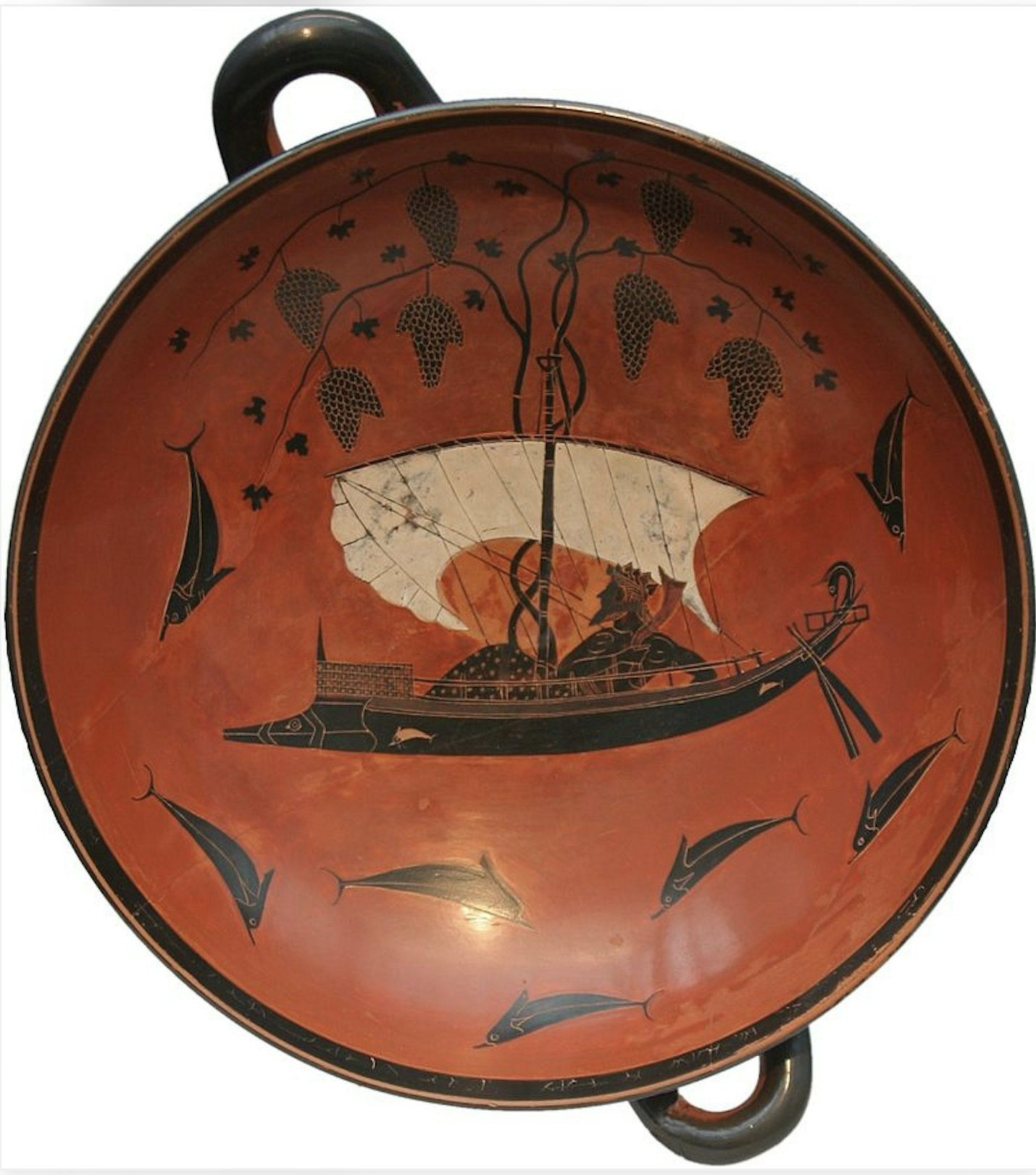
Then wine begins to flow across the ship. A vine climbs the mast and spreads over the sail. Ivy winds around the vessel. Dionysus appears as a lion, and the terrified sailors leap into the sea, where they become dolphins. The helmsman alone is spared.
The important point comes before any of these wonders.
Dionysus was already a god when the pirates captured him.
The miracles do not make him divine. They reveal what was present from the beginning.
The famous cup painted by Exekias in the sixth century BC offers a wonderfully similar vision. Dionysus reclines within a ship while a great vine rises above him and dolphins swim around the hull. We should not assume that Exekias was simply illustrating the surviving Homeric Hymn, but both works imagine the god at sea through the same extraordinary combination of ship, vine and dolphins.
Born More Than Once
After all this, perhaps it should not surprise us that even the birth of Dionysus refuses to fit comfortably within ordinary categories.
His mother Semele is mortal, the daughter of Cadmus of Thebes; his father is Zeus. Hera persuades Semele to demand that Zeus reveal himself to her in his divine splendour. Bound by his promise, Zeus does so, and Semele is consumed.
The unborn Dionysus survives. Zeus rescues him and sews him into his thigh, carrying him until he is ready to be born.
Dionysus therefore enters the world through both mortality and divinity. His mortal mother dies before his birth, yet he survives within the body of his divine father. He belongs to the Olympian family while remaining forever the son of Semele.
Other Dionysiac and Orphic traditions tell different stories, including accounts of Dionysus being destroyed and returning. They come from different periods and contexts and should not be forced into a single canonical biography.
Greek religion does not require us to decide upon one authoritative ‘life of Dionysus’. What is striking is how readily traditions surrounding this particular god return to multiple births, changing forms, disappearance and return.
And eventually these traditions lead towards the one passage no mortal can avoid.
Dionysus and Death
Death gives the traditions surrounding Dionysus a different weight.
Dionysiac and Orphic material from different periods connects the god with initiation, the Underworld and hopes concerning the fate of the dead. The evidence is difficult and should not be assembled into a single ‘Orphic religion’ with a fixed creed. No universally accepted Orphic scripture survives, and beliefs and practices differed across communities and centuries.
Nevertheless, some of the evidence is remarkably intimate.
Small inscribed gold tablets have been found in graves across parts of the Greek world. They address the dead directly, offering instructions for the journey beyond life and speaking of purity, divine belonging and the hope of a different fate after death.
Among the most striking are the tablets from Pelinna, placed with the dead in Thessaly in the fourth century BC. They tell the deceased that Bacchios himself has released them and speak of the dead person as having died and now been born.
Whatever precise theology lay behind these words, Dionysus is no longer simply beside the wine cup or upon the theatre stage.
He is present at the grave.
This does not give us a single Dionysiac doctrine of the afterlife, nor does it make Dionysus simply a god of resurrection. It tells us something subtler. For some worshippers, their relationship with Dionysus still mattered at the moment when ordinary human life came to an end.
The person who drinks wine returns eventually to sobriety. The actor removes the mask. The Bacchant returns from the mountain.
Death offers no such ordinary return.
Yet even there, some Greeks approached Dionysus.
Recognising the God
Calling Dionysus the ‘god of wine’ is not wrong. Wine lies at the heart of his identity. But following Dionysus through Greek religion takes us far beyond the drinking cup.
Wine alters consciousness. Mania opens the possibility of divine presence within the human mind. The actor disappears behind a mask so that another identity can appear. The god himself walks among mortals as a stranger. For some initiates, his presence reaches even to the grave.
It would be tempting to gather all these traditions together and declare Dionysus simply the ‘god of transformation’ or the ‘god who crosses boundaries’. But the Greeks worshipped a god, not an abstraction, and no modern formula can contain the full range of his myths, cults and epithets.
His name was already known in the Mycenaean world, yet Greek myth continually allows him to arrive from somewhere beyond the familiar. He comes from Lydia, to Thebes, aboard a ship, into the city and onto the stage. Sometimes he brings wine and joy; sometimes something far more unsettling.
Perhaps there is no contradiction here at all. A god who arrives need not previously have been absent.
The pirates already have Dionysus aboard their ship when they mistake him for a mortal. Pentheus already stands before his god when he believes he is questioning a foreign stranger.
The god is already present. The question is whether we recognise him.