


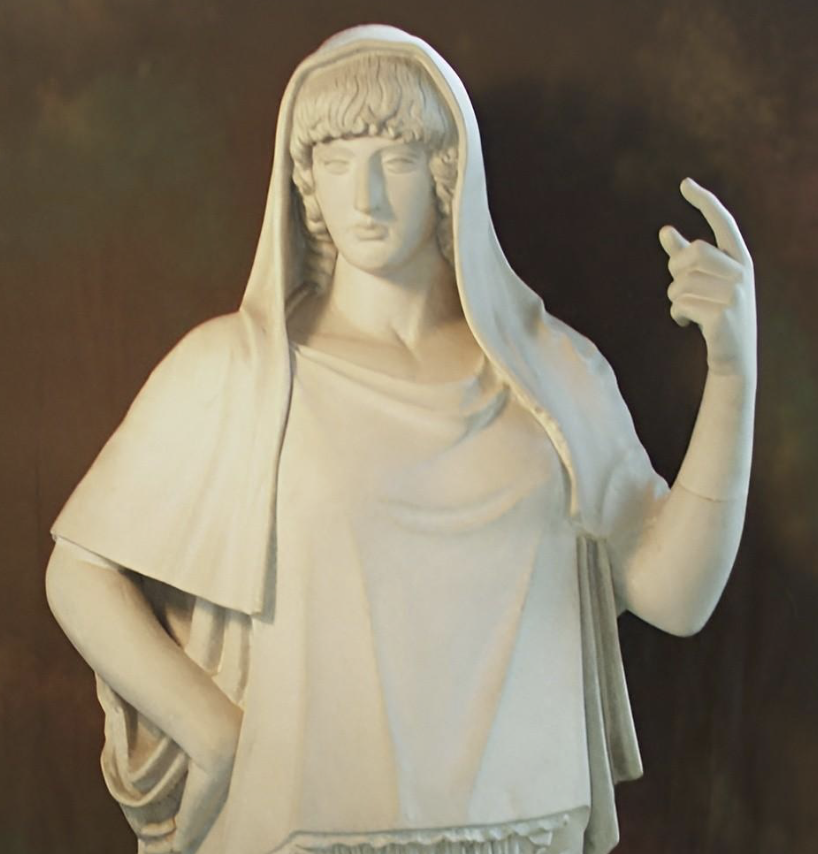
Hestia is one of the Olympian gods. She is a daughter of Kronos and Rhea, sister to Zeus, Hera, Demeter, Poseidon and Hades. Yet compared with the rest of her family, remarkably little happens to her.

She fights no monsters, takes no mortal lovers and does not wander across the Greek world in disguise. There is no great cycle of stories about her adventures, quarrels or punishments. Even in Greek art, she is surprisingly difficult to find. It would be easy to conclude that Hestia simply mattered less than the more colourful gods around her.
Greek religious practice suggests almost exactly the opposite.
Her name, Hestia, is also the Greek word for the hearth. She receives offerings in the household, but her presence extends far beyond the domestic fire. The city has its Hestia too, and her sacred fire could travel with Greeks establishing new communities across the sea.
The goddess with almost no stories is remarkably difficult to avoid.
At the Hearth
Calling Hestia simply the ‘goddess of the home’ does not quite capture her place in Greek life. The hestia is a physical hearth, where food is cooked and people gather, but it also belongs to the religious life of the oikos, the household.

Greek domestic arrangements varied considerably. Archaeology reveals hearths, braziers, altars and cooking spaces rather than a single standard form of the Greek household hearth.
We should not imagine every Greek house as having a grand, permanently burning fireplace at its architectural centre. Archaeology gives us a messier picture. Cooking might be done on simple hearths or portable braziers, and domestic arrangements varied considerably across periods and places.
Imagine, then, something considerably less spectacular than a great festival or a sacrifice on the Acropolis. A meal is being prepared in an ordinary house. Before the household eats, a small portion of food may be offered at the hearth. Before wine is drunk, some may be poured for Hestia. There is no need to go to a temple. The gods are already part of the meal.
Fire has a profound place in Greek worship more generally. At sacrifice, offerings are consumed in it and smoke rises towards the gods; incense burns and libations accompany ritual. The household fire belongs within this same religious world.
This is easy to miss if we approach Greek religion mainly through mythology. Myths naturally favour the extraordinary: gods descend from Olympus, heroes fight monsters and mortals discover, usually too late, that they have offended someone divine. Most religious life is less dramatic. People eat, children are born, guests arrive, people marry and die, and through all of this relationships with the gods are maintained.
First and Last
One of the Homeric Hymns to Hestia gives us a glimpse of what this meant in practice:
“For without you mortals hold no banquet,
where one does not duly pour sweet wine
in offering to Hestia both first and last.”
Homeric Hymn 29 to Hestia, trans. Hugh G. Evelyn-White
The hymn gives Hestia an “everlasting abode” in the dwellings of both gods and mortals. Her honour does not merely form part of the feast; it frames it.
The same principle appears beyond the household. Pausanias, describing the sacrifices made at Olympia centuries later, gives Hestia first place in the sequence, before even Olympian Zeus. This does not mean that Hestia is secretly ‘more important’ than Zeus. Greek religion does not need to be turned into a league table of divine importance. Rather, Hestia has a particular relationship with beginnings and the proper opening of sacred and communal activity.
This brings us close to an important idea in Greek religion: kharis. The word can mean grace, favour or goodwill, and in religious life it belongs to the reciprocal relationship between gods and mortals. People honour the gods through prayer, sacrifice, libation and dedication, and hope for divine favour in return. This is not a commercial exchange in which a measure of wine purchases a corresponding amount of good fortune, but a relationship sustained through giving, receiving and remembering.
Hestia shows us how ordinary that relationship could be. Worship need not wait for a crisis, an oracle or a great public festival. A little wine is poured, a portion is offered and the goddess receives her honour. At another meal, it happens again. Religion is sustained as much through repetition as through revelation.
Who Belongs Here?
The hearth also helps define the household itself.
In Classical Athens, a ceremony known as the Amphidromia took place shortly after the birth of a child. Its most memorable feature was startlingly simple: the newborn was carried around the household hearth. We cannot reconstruct every detail of the ceremony with certainty, but it clearly brought the new child into ritual contact with the hearth and has often been understood as part of the process by which the child was received into the household.
The oikos was more than a collection of people living under one roof. It had its property, customs, ancestors and relationships with the gods. Becoming part of it therefore meant entering a world that was religious as well as social.
Marriage brought another sort of newcomer. A Greek marriage involved movement between households: the bride left one oikos and entered another, where the hearth had a place in the rituals surrounding her arrival. Other newcomers, including slaves, could also encounter rites associated with it. Who belongs within this house, who eats with us and who shares our fire are social questions, but in a Greek household they could also be religious ones.
This gives an interesting context to one of the few substantial myths about Hestia herself. In the Homeric Hymn to Aphrodite, Poseidon and Apollo both seek her in marriage. Hestia refuses them and, placing her hand upon the head of Zeus, swears that she will remain a virgin forever. Zeus grants her a special honour in return: she will have her place in the midst of the house and receive honour among mortals.
It would be easy to turn this into a modern story about Hestia choosing independence. That is probably more revealing of us than of the Greeks. There is, however, a striking contrast within the ancient world itself. Marriage normally takes a woman from one household to another. Brides come to a new hearth; Hestia never does. The goddess who receives others into the sacred life of the household keeps her own place within it.
The Hearth of the City

The remains of the Prytaneion at Olympia. The prytaneion was the civic hearth of the community, associated with Hestia and with public dining and hospitality.
The pattern does not stop at the front door. A Greek polis could have a common civic hearth associated with Hestia, usually located in the prytaneion. This belonged to the public life of the community: magistrates and honoured guests might dine there, foreign ambassadors could be received there, and the civic hearth represented the community itself.
A polis was certainly not simply an enormous family, but the parallel is striking. Pindar addresses Hestia in precisely this civic setting, invoking her in connection with the prytaneion and those who govern. The scale has changed from oikos to polis, but Hestia belongs to both.
Carrying the Fire
Perhaps the most vivid expression of this comes when Greeks leave home altogether.

Greek settlement spread across the Mediterranean and Black Sea during the Archaic period. New communities maintained religious and cultural relationships with the cities from which their settlers had come.
From the Archaic period onwards, Greek communities established settlements across the Mediterranean and Black Sea. People travelled enormous distances to places where they would have to build houses, establish sanctuaries, divide land and create new political communities. Colonists could take fire from the civic hearth of their mother city to the new settlement.
A new community might stand hundreds of miles away, but its civic hearth could be kindled from the old one. For the settlers, this was not merely a journey to somewhere new. They were establishing another place in which humans and gods would live together: new households, new sanctuaries, new sacrifices and a new civic community. The fire carried from the mother city connected that beginning with what had come before.
To found a new city, the Greeks did not simply find somewhere new to live. They carried the old hearth with them.
When the Fire Goes Out
Fire can also be extinguished, and here the comfortable modern image of Hestia as a cosy domestic goddess begins to look rather inadequate.
Greek religion was deeply concerned with miasma, usually translated as pollution. Certain events, particularly death and bloodshed, could place individuals or communities in a religious condition requiring purification. Plutarch preserves a tradition from Argos in which the death of the head of a household meant that the household fire was extinguished and new, pure fire obtained.
He also records a much larger story following the Persian Wars. Fires in Greek territories occupied by the Persians were regarded as polluted, and the Delphic oracle instructed the Greeks to extinguish them and obtain pure fire again from Delphi. The historical details come to us through a much later author, but the religious idea is revealing.
The fire can be pure, become polluted, be extinguished and renewed. Hestia’s world is therefore not simply one of domestic comfort and permanence. Continuity sometimes requires restoration.
Come Into This House

The sanctuary of Apollo at Delphi. One of the Homeric Hymns addresses Hestia here, tending the sacred house of Apollo at Pytho.
One of the shortest Homeric Hymns takes us somewhere rather grander than the domestic hearth, to Apollo’s sanctuary at Delphi:
“Hestia, you who tend the holy house
of the lord Apollo, the Far-shooter at goodly Pytho …
come now into this house …
draw near, and … bestow grace upon my song.”
Homeric Hymn 24 to Hestia, trans. Hugh G. Evelyn-White
The language is worth noticing. Hestia is not merely identified with a fireplace or used as a metaphor for stability. She is addressed and invited to draw near.
The other Homeric Hymn does something similar. After describing Hestia’s place in the dwellings of gods and mortals, it turns to Hestia and Hermes:
“Come and dwell in this glorious house in friendship together.”
Homeric Hymn 29 to Hestia, trans. Hugh G. Evelyn-White
The gods are invited into the house, honoured there and asked for their favour.
The later Orphic Hymn to Hestia comes from a different religious and historical setting, but the relationship is still recognisable. Hestia is addressed as dwelling at the centre with her everlasting fire, and the worshipper asks her to accept the offerings kindly and grant prosperity and health.
Across the centuries, the language changes, but Hestia remains someone to whom one can pray.
The Goddess Who Stays
Later Greek thought develops Hestia’s association with permanence in interesting ways. In Plato’s Phaedrus, Zeus leads the gods in their great procession through heaven, while Hestia alone remains in the house of the gods.
We should not turn this into a complete explanation of Hestia. Plato is not giving us a handbook of household religion, and modern scholarship has rightly questioned older attempts to reduce her to an abstract principle of immobility. She is a goddess, not a philosophical diagram of a fireplace.
Yet Plato’s image draws upon something recognisable. Other gods travel, hunt, fight, pursue and arrive. Hestia’s place is characterised by remaining. The dramatic encounter with a god, so familiar from mythology, is not the only way divine presence can be experienced.
Perhaps this is also why Hestia needs so few stories. Myth usually begins when someone leaves home: Odysseus sails to Troy, Heracles sets out on his labours, Persephone is taken from her mother and Dionysus arrives from elsewhere. Hestia remains, but remaining does not mean doing nothing. Around her hearth people eat, worship and become part of a household; beyond it, the city gathers around a common sacred fire, and from that fire another hearth may be kindled across the sea.
Her presence belongs not to the exceptional moment but to the repeated acts through which people make a life together and maintain their relationships with the gods. Other gods may arrive in thunder, prophecy, madness or epiphany. Hestia is encountered rather differently.
She is already at the hearth.